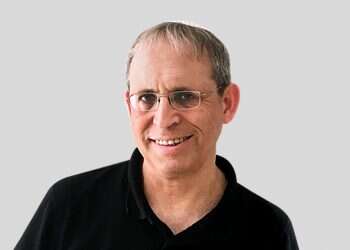
I'm a believing Jew. I believe in the value of equality in general and equal opportunity between genders in particular. I believe in science as a means to interpret our lives in general and in the principles of evolution in particular. I consider myself a traditional Jew, as my father and his father before him were atheists. Therefore, I represent the third generation of atheist Jews. I define myself as a humanistic secular Jew. As a humanist, I place the individual at the center of the universe and aspire to be of benefit to as many people as possible.
As a secular Jew, I view Judaism as a culture. Jewish culture is rich and incredibly diverse and includes the Jewish religion, which I have chosen not to observe. I distinguish between religious texts, customs and tradition, which I view as a source of inspiration – and belief in a God and religious practices, which I decline. I transitioned from being a non-religious person to a conscientious, engaged secular Jew several years ago after realizing that Jewish culture provides immense spiritual resources – and that this heritage is a part of me. It is an important component of my identity, and it is important for me to cultivate it. My Jewish culture is predicated on the spiritual resources that developed across generations of Jewish culture and consist of those religious streams consistent with my humanist and secular views.
In the belief that it's important to hold respectful dialogue between the religious and secular publics in the country in general, and between Jews from different streams in particular, I joined the "Limmud" initiative, which invited Jews from all streams to take part in an annual festival, come learn and also teach a variety of subjects pertaining to our Jewish and Israeli world. I volunteer with Limmud in the conviction that it's right and possible to strengthen the bonds between Jews of all streams in a noncoercive manner.
Limmud espouses unity over uniformity. Meanwhile, in the understanding that the perception of Judaism as a culture should be reinforced in the secular public, four years ago I established "Reim" ("Friends") – a secular humanist Jewish community in Modiin-Maccabim-Reut. We celebrate Israeli Jewish culture in any number of ways. We welcome Shabbat together, hold activities on the holidays, travel the country, meet for study sessions and more. Upon establishing the community I began secular rabbinical studies at Tmura, the Institute for Training Secular Humanistic Rabbis and Jewish Leadership in Israel, where I encounter an amazing group of leaders in the secular public.
Among the significant dates on the Jewish calendar, Shabbat for me is a cultural asset I am unwilling to forego. It is one of the most vital gifts bequeathed to the world by the Jewish people. Whether because it is a resource for society that brings people closer or because it is a special time specifically set aside to foster family bonds. Shabbat allows me to stop and think about the past week. It provides the time for a family hike in nature or just quality family time, without the usual interruptions and distractions of our smartphone dominated lives. I am all for technology as long as it serves us: for example using GPS technology to find a picnic spot we chose, or to forge relationships with relatives. As a rule of thumb, however, on Shabbat I personally try disconnecting from anything distracting, as much as possible at least.
Shabbat belongs to all of us and we are all welcome to enjoy it according to our beliefs. Come join me for a Shabbat of tranquility, a Shabbat of enjoyment at museums and theaters, at the beach or a hike in nature, a Shabbat where we love the country and one another.