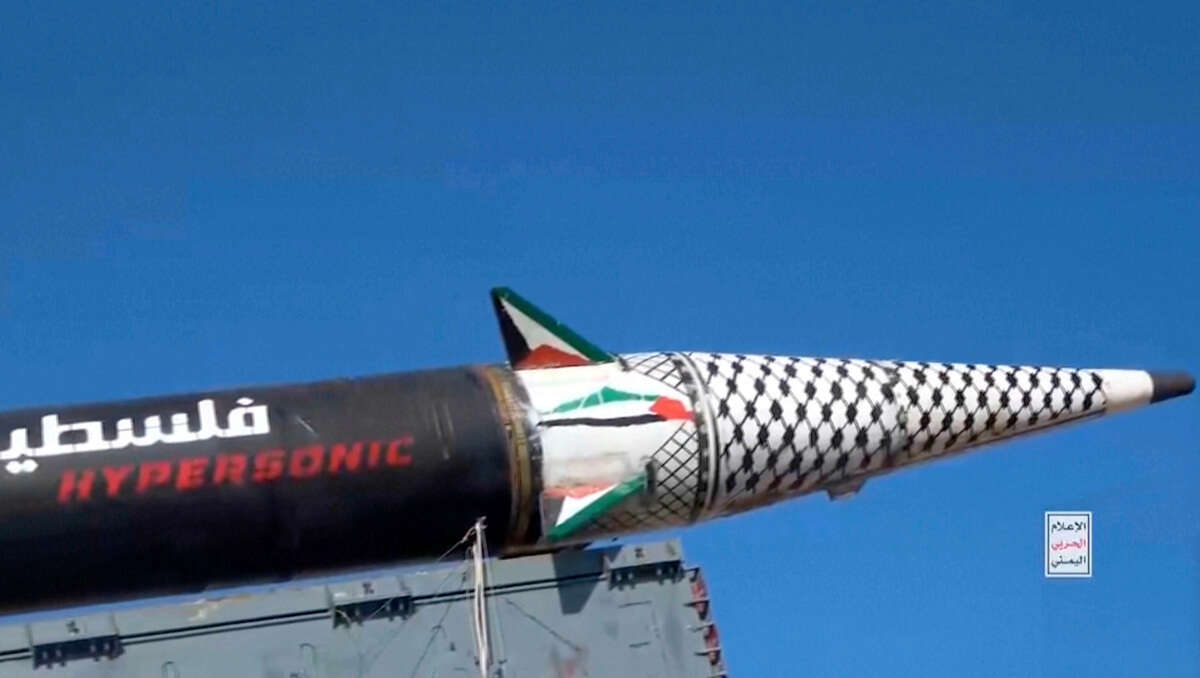
The Wall Street Journal reported Wednesday that Houthi forces are actively utilizing Chinese parts to build medium-range ballistic missiles, signaling a major technological leap for the Iranian-backed terror group organization. Conflict Armament Research found that the Yemeni group acquired vital components from an Asian supplier to recreate Iran's Kheibar Shekan projectile, a precision-guided platform featuring a strike radius of 1,200 miles (1,931 kilometers), threatening both Israeli and Saudi soil, according to the outlet.
Having already targeted US bases with the Kheibar Shekan during spring clashes, Tehran previously proved the system's effectiveness. Escalating their attempts to bypass a Saudi-led blockade, Houthi fighters have intensified regional attacks recently, driving up global oil markets. Frustrated by the chaos and simultaneous Iranian harassment of commercial shipping, President Donald Trump stated Tuesday on Truth Social that the proxy group was behaving "very badly" in the Middle East.

"When you have imports like that, there is a possibility that they are already manufacturing or that they are trying and it doesn't really work out," Fabian Hinz of Conflict Armament told The Wall Street Journal. Hidden manufacturing facilities make it difficult to assess their true progress. Known for outmaneuvering air defenses, the Kheibar Shekan utilizes a detachable warhead equipped with micro-thrusters to navigate at 6,000 miles an hour (9,656 kilometers an hour) just before impact.

Moving away from assembling smuggled Iranian hardware, the organization has achieved indigenous capabilities. "They have developed domestic manufacturing capabilities with artificial intelligence for drone and missile softwares, diversified their supply chains, accumulated operational experience, and established relationships with regional smugglers and international procurement networks," risk analyst Mohammed al-Basha, noted.
Chinese enterprises overwhelmingly dominate the supply chain for intercepted Houthi contraband, circumventing the UN arms embargo and US terrorism sanctions, according to foreign reports. Henry Thompson, a former UN panel expert, confirmed solid-fuel technology has arrived from China for years. "the Houthis can reach deep into Saudi Arabia with a bigger payload than cruise missiles and drones," he explained. "They are going to be a more potent threat."

Despite Beijing's denials of embargo violations, Michael Knights of Horizon Engage argued this trade proves China has "neither the will nor the means to control the final destination of its dual-use technologies." Customs agents discovered ablative heat shields, flight fins, custom aerospace fuselages, and diagnostic tools matching the Kheibar Shekan design. According to The Wall Street Journal, shipping manifests tied these specialized aerospace materials directly to an anonymous Chinese precision-metal manufacturer.
China's ambassador to Israel, Xiao Junzheng, recently told Israel Hayom his country does not sell weapons to Iran but he stopped short of embracing the economic isolation effort led by Washington.
"We never sell weapons or provide ammunition to countries at war or to conflict zones," Xiao insisted. According to Xiao, "China has been working to promote peace talks, and will continue to play its role for an early end to the conflict and restoration of peace in the Middle East."
In August 2025, Xiao attacked "anonymous sources" for spreading misinformation on China. "We have noticed that for some time now, some anonymous sources have been cited to make baseless speculations and vilification against China, spreading rumors such as China provides weapons to Iran, China helps Iran to restore ballistic missile capabilities and China–Iran military cooperation harms Israel's national security. A lie repeated a thousand times is still a lie," Xiao, who also served as third and second secretary in the Chinese Embassy in Iran some 20 years ago, told Israel Hayom.