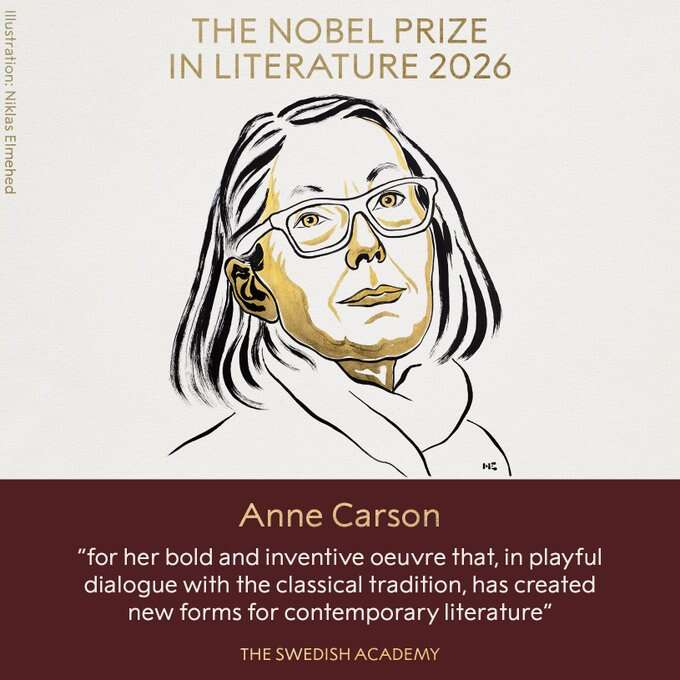
Anne Carson, the Canadian poet and author, was awarded the 2026 Nobel Prize in Literature. According to the committee, she received the honor "for her bold and inventive oeuvre that, in playful dialogue with the classical tradition, has created new forms for contemporary literature."
This year's #NobelPrize laureate Anne Carson was born in 1950 in Toronto, Canada. In 1981, she published her doctoral thesis in Classics entitled 'Odi et Amo Ergo Sum', and has, throughout her entire career, combined poetry writing with translation work and teaching at various universities.
Almost all her literary production has centred upon the intersection between the philologist's obsession with words and the poet's desire for new meaning. She has herself identified the etymology of words as the starting point for all her work.
— The Nobel Prize (@NobelPrize) October 8, 2026
Born in Toronto in 1950 Carson completed a PhD in the field of Classics, whose 1981 dissertation was titled "Odi et Amo Ergo Sum" for her dissertation in 1981. Over the ensuing decades she engaged in translation and writing while teaching across different campuses. "Almost all her literary production has centered upon the intersection between the philologist's obsession with words and the poet's desire for new meaning. She has herself identified the etymology of words as the starting point for all her work," The Nobel Prize Committee said on X. Dispensing 12 million Swedish crowns ($1.2 million), the Swedish Academy bestows this honor. The Canadian author famously synthesizes prose, verse, and dialogue, drawing heavily on her classical Greek translations to shape varied works, including the 1998 verse novel "Autobiography of Red". Her signature genre-bending is evident in "Norma Jeane Baker of Troy", a 2019 stage piece merging Marilyn Monroe's history with the Euripides play "Helen."
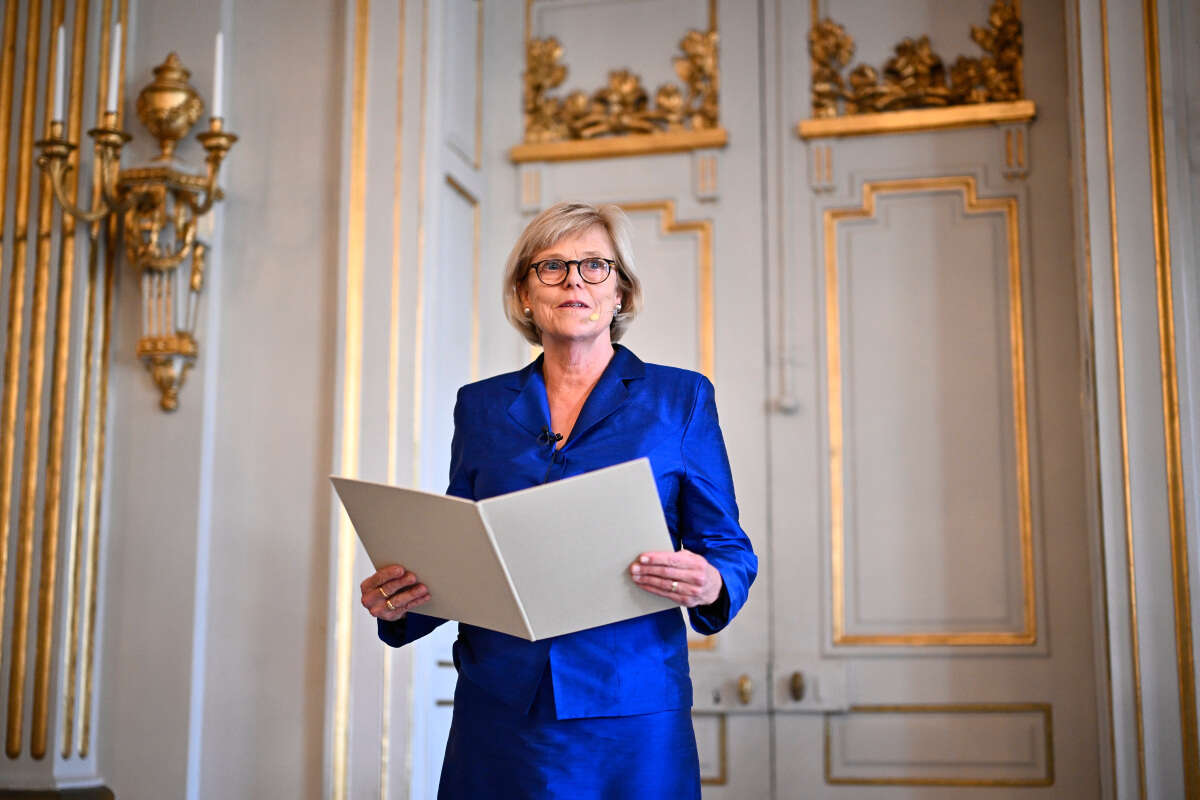
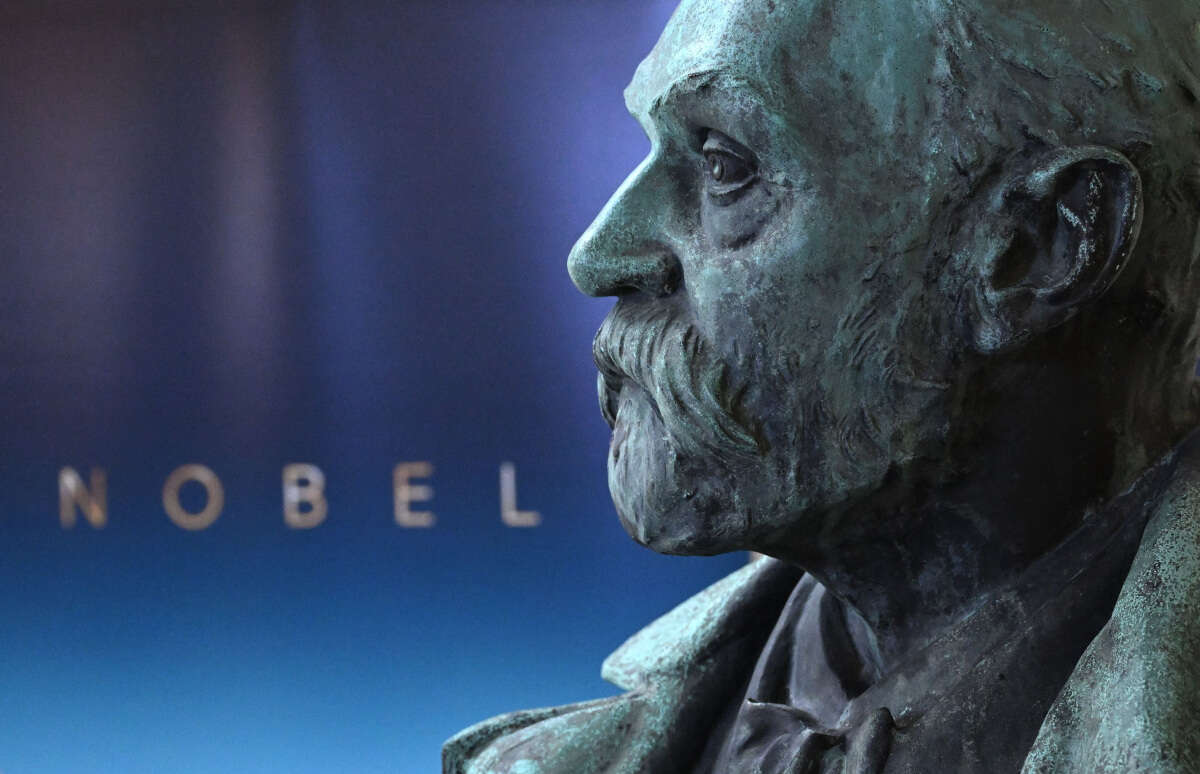
Following heavyweights like Alice Munro and Ernest Hemingway, Carson enters a pantheon that often draws scrutiny, Reuters reported. Detractors routinely criticize the Academy for overly obscure selections and for historically ignoring titans like Virginia Woolf and Leo Tolstoy, alongside a general lack of US winners – except for Bob Dylan's 2016 victory. Conversely, loyalists argue the committee rightfully promotes global literary diversity while also recognizing beloved figures like Gabriel Garcia Marquez. Financed by inventor Alfred Nobel, the awards began in 1901. Last year, Hungarian novelist Laszlo Krasznahorkai – labeled the "master of the apocalypse" by Susan Sontag – took the literature crown, Reuters said.
The Academy cited Krasznahorkai "for his compelling and visionary oeuvre that, in the midst of apocalyptic terror, reaffirms the power of art." Born in 1954 in Gyula, near the Romanian border, he is the second Hungarian to take the literature prize, after Imre Kertész in 2002. The judges placed him in a Central European line running from Kafka to Thomas Bernhard, a tradition they said is marked by absurdism and grotesque excess.
The year before, the prize went to Han Kang of South Korea, "for her intense poetic prose that confronts historical traumas and exposes the fragility of human life." She was the first South Korean laureate and the 18th woman to win the literature prize since 1901. Anders Olsson, chair of the Academy's Nobel committee, said she has "a unique awareness of the connections between body and soul, the living and the dead," and that her experimental style has made her an innovator in contemporary prose.
Her international breakthrough was The Vegetarian, which won the 2016 International Booker Prize. It follows a woman who, after violent dreams, stops eating meat and tries to live as a plant. Human Acts turns to the 1980 Gwangju massacre and the way that violence remains in a population across generations.
In 2023 the Academy chose the Norwegian Jon Fosse "for his innovative plays and prose which give voice to the unsayable." Fosse is among the most performed living playwrights, and his fiction is built on repetition, silence, and sentences that refuse to stop. The seven-part Septology is the clearest case: a continuous meditation written almost without full stops.