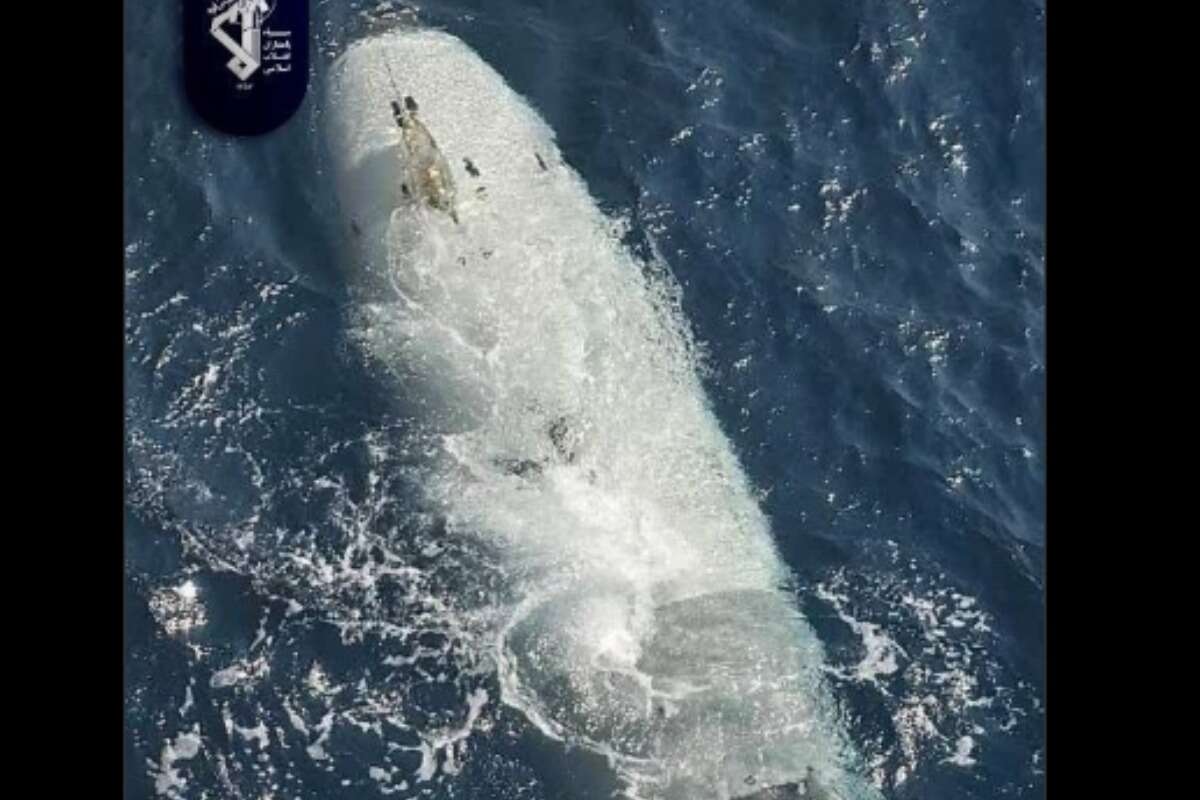
Iran's state media said on Tuesday that the IRGC navy had seized an unmanned US submersible near the mouth of the Strait of Hormuz, though US officials have offered no confirmation of the incident.
The operation, according to a Tuesday statement from the Revolutionary Guards' Navy, took place in the early hours of the day and was described as a "complex intelligence and operational action."
Delivered to the US military in 2025, the submersible is built with some of the most advanced underwater technology available, the statement said.
Tasnim, an Iranian state news agency, reported that the captured system is a Dive-LD, an autonomous unmanned underwater vehicle built by US defense firm Anduril Industries and first handed over to the US Navy's Unmanned Undersea Vehicle Group 1 in 2025. Roughly 19 feet (5.8 meters) long and about 4 feet (1.2 meters) in diameter, the vehicle weighs close to 3 tons (2.7 tonnes), according to Tasnim's report.
Its published specifications list an underwater endurance of up to 10 days and a maximum operating depth of about 19,700 feet (6,000 meters).
The standoff at Hormuz traces back to Feb. 28, 2026, when the US and Israeli strikes on Iran – including the killing of Supreme Leader Ali Khamenei – were launched as part of a pre-emptive war after Tehran refused to abandon its nuclear program. Iran responded by shutting the strait to all foreign shipping, with the IRGC warning vessels over radio that passage would not be permitted. An ensuing standoff with occasional skirmishes has ensued despite a short-lived official agreement being declared in June to prevent further confrontations.
Earlier on Tuesday, the Treasury Department's website revealed that the Trump administration had sanctioned one individual and upward of 30 entities, airlines among them, for their ties to Iran's aviation sector.
In August, Treasury Secretary Scott Bessent laid out a new round of sanctions designed to further cut off Iran. The announcement followed earlier warnings of "an economic D-Day."
The coming measures will zero in on multinational companies doing business with Iran across aviation, gold, crypto, oil and shipping. Bessent said Trump has been personally reaching out to foreign leaders, pressing them with "specific requests" to cut economic ties with Tehran.
According to the NBC News review, the secretary framed the effort as an "economic onslaught" targeting Iran's financial links "around the globe," with the stated aim of moving to "sever every economic pipeline" the country depends on "until Tehran stands alone."

Bessent said the US has relied on "quiet diplomacy" to warn trading partners of the consequences of continued business with Iran, adding that banks caught laundering money for the regime will be permanently locked out of the American financial system.
Investors largely shrugged off the remarks, and the administration gave no specific timeline for enforcement. NBC News' assessment pointed out that Washington has spent decades sanctioning Iranian entities linked to weapons programs, though Tehran has repeatedly dodged those measures through shell companies.