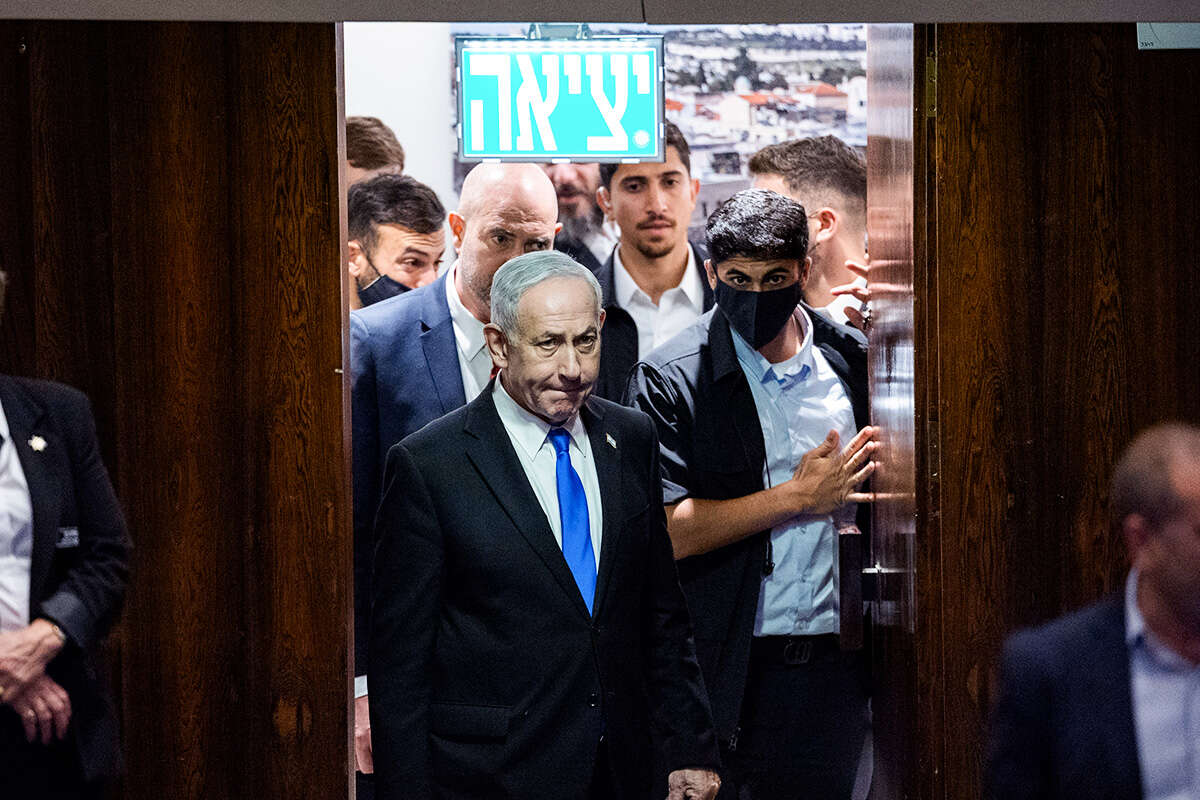
Shortly after Oct. 7, a nightmare scenario for Prime Minister Benjamin Netanyahu began circulating in Likud for the first time: an organized putsch from within his own party aimed at removing him from the Prime Minister's Office.
According to Likud officials, the driving force behind the effort was Economy and Industry Minister Nir Barkat, who began attacking Netanyahu both from the Right, over his policy in Gaza, and from the Left, over the establishment of a state commission of inquiry and the military draft law. Barkat sought to advance a constructive no-confidence motion with opposition support and form a government under his leadership, but the attempt ultimately failed.
Despite that, some in the political system are now reviving the idea, just ahead of the dramatic Likud primary, in which at least half of the members of the party's current Knesset slate are expected to lose realistic spots on the ticket and find themselves out of the Knesset.
The idea is simple: After the primary, with a sizable number of disappointed Likud MKs still serving in the Knesset, a constructive no-confidence motion could once again be brought to a vote. One possibility, purely by way of example, would be a transitional government headed by MK Benny Gantz, who could serve as a compromise candidate around whom politicians on the Right, and even the ultra-Orthodox parties, could rally.

The result would be Netanyahu's removal from the Prime Minister's Office even before the election, diminishing his ability to shape the public agenda and, more importantly, restricting his room for maneuver in future coalition negotiations. After all, Netanyahu, as a rank-and-file MK, would clearly be in no position to push for yet another election.
Against all this, however, one point must be stressed: The chances of such a scenario materializing are not high. That is not because there is any shortage of anger toward Netanyahu within Likud, or of people who would like to see such a move take place. Nor would there be any shortage of MKs with nothing left to lose after the primary.
Rather, the main obstacle is ego. It is difficult to see the opposition coalescing around a single candidate, unless perhaps that candidate were Gantz, on the condition that in return he pledge to retire from politics and not run in the election.