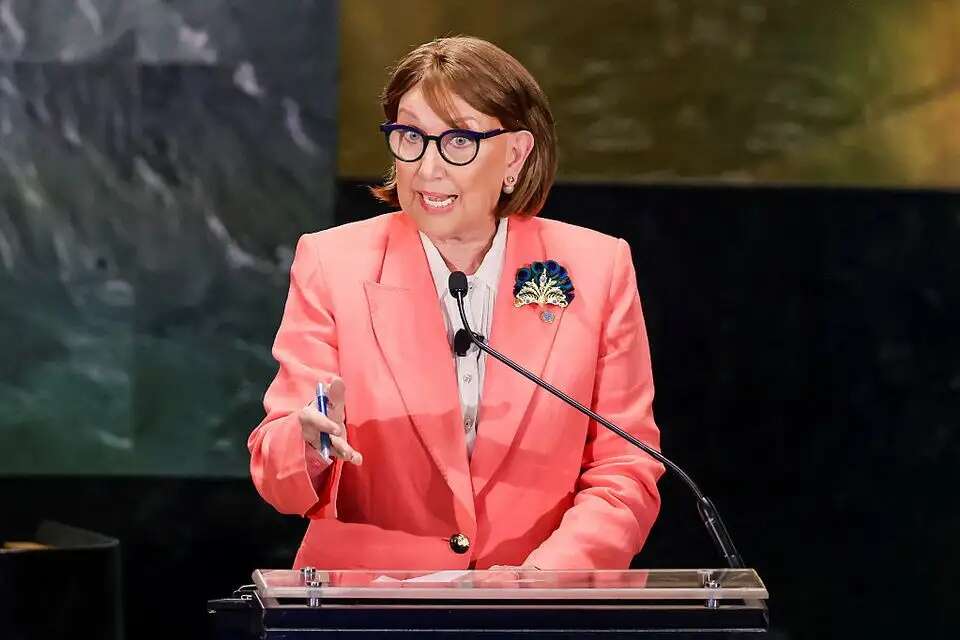
The race to choose the next UN secretary-general has taken a surprising turn, with Rebeca Grynspan, a Jewish Costa Rican economist and former vice president, emerging as the frontrunner.
In the first informal straw poll among the 15 members of the UN Security Council, Grynspan received 10 votes of encouragement, one discouragement and four no opinions, the strongest result among the seven candidates. The confidential poll was held July 30.
If chosen, Grynspan would become both the first woman and the first Jew to lead the United Nations.
Her parents fled Poland before the Holocaust, while her maternal grandparents were murdered by the Nazis. Grynspan has said she is proud of her Jewish identity. Her sister moved to Israel at 17, and her nephews served in the Israel Defense Forces. In remarks at the UN, she described herself as a "daughter of peace," saying peace had enabled her refugee parents to build a new life in Costa Rica.
Rebeca Grynspan, the UN's current Secretary-General of Trade and Development is hoping for a promotion to the organization's top job when Antonio Gutterres steps down at the end of this year. She speaks exclusively to @CGTNEurope's #TheAgenda.#un #grynspan pic.twitter.com/ZDmzr0zvlc
— CGTN Europe (@CGTNEurope) August 3, 2026
Her identity, however, does not necessarily translate into positions favorable to Israel. Grynspan is secretary-general of UN Trade and Development, formerly known as the UN Conference on Trade and Development, which has published sharply critical reports on Israel. She has headed the organization since 2021.
A UNCTAD study published this year estimated that "occupation, restrictions, closures and military operations" had cost the Palestinian economy about $212.2 billion in potential gross domestic product between 2000 and 2024. The figure, stated in constant 2015 dollars, was equivalent to 19.4 times the Palestinian economy's 2024 GDP.
Grynspan has also stressed the need for humanitarian access to Gaza, warned against using humanitarian assistance as a "weapon" and pledged to implement Security Council resolutions concerning the Gaza Strip. From Israel's perspective, despite her Jewish identity, she remains associated with the broadly critical approach toward Israel prevalent at the UN.
Her main rival is Carolyn Rodrigues-Birkett, Guyana's ambassador to the UN and a former foreign minister, who received nine votes of encouragement and two discouragements in the first straw poll. Rodrigues-Birkett has presented herself as a pragmatic candidate who would make the organization more efficient, but on Israel she has taken clear positions.
At the Security Council, she has said Guyana was unwavering in its support for the Palestinian cause, called for implementation of the two-state solution and portrayed the Palestinian issue as central to the upheaval afflicting the Middle East. Her record is likely to be viewed in Jerusalem as a continuation of the UN's traditional approach toward Israel. Her experience and the relatively limited opposition to her candidacy make her a serious challenger to Grynspan.

In third place is International Atomic Energy Agency Director General Rafael Mariano Grossi of Argentina, with seven votes of encouragement and two discouragements. From Israel's perspective, Grossi is probably the most comfortable of the leading candidates. He is deeply familiar with Iran's nuclear program, favors practical diplomacy and has argued that UN agencies must not merely act but ensure that their work is useful and does no harm. Grossi has headed the IAEA since December 2019 and has extensive experience in nuclear nonproliferation and disarmament. On the Palestinian issue, however, he has maintained a more institutional line, pledging to work with both Israel and Arab states and acknowledging the issue's central place on the UN agenda.
Former Chilean President Michelle Bachelet remains a prominent contender but has lost some ground after receiving five discouragements and losing the backing of her own government. Chile withdrew its sponsorship of her candidacy in March, leaving Brazil and Mexico as her nominating countries. For Israel, Bachelet is a more problematic candidate. She has defended the importance of the UN Relief and Works Agency for Palestine Refugees, called for humanitarian agencies to receive adequate resources and political support, and emphasized the need to enforce UN decisions and international law.
Further polls are expected. To be selected, a candidate ultimately needs at least nine votes in the Security Council and must avoid a veto by any of its five permanent members: the US, Russia, China, France and Britain. The Security Council will recommend a single candidate to the General Assembly, which will then vote on the appointment. The next secretary-general is due to begin a five-year term on Jan. 1, 2027.